
Something for the Weekend 7
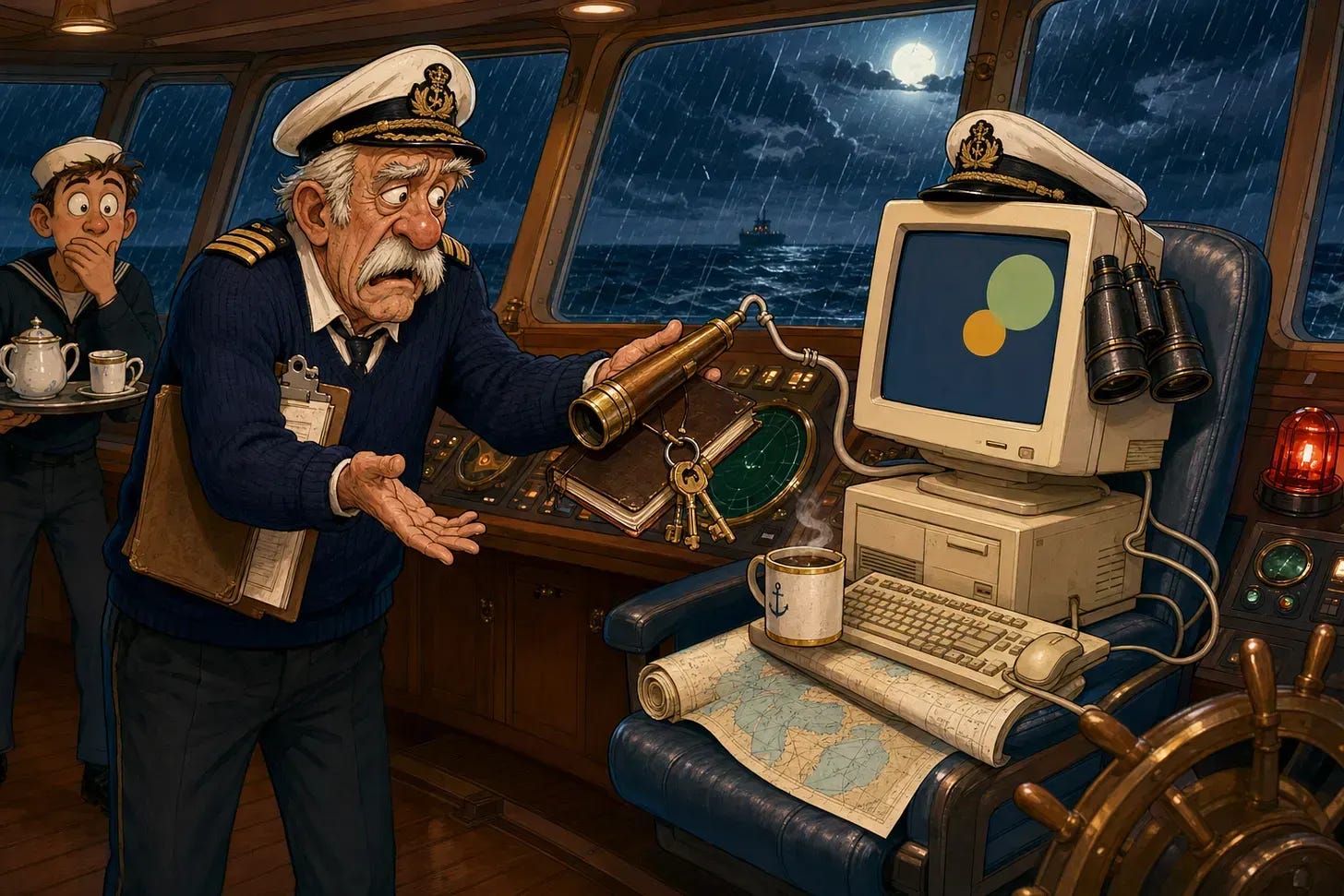
Hi ,
This week: a four-hundred-year-old ritual for handing a ship over to the next man without losing anything important in the gap. A cave in Eswatini where someone spent forty-three thousand years digging for a colour with no practical use whatsoever. A hundred unexplained objects off the Virginia coast that the Pentagon’s own anomaly office can’t close the file on. And a paid subscriber who cancelled, then asked me for a consultancy call. That’s the deal.
These weekly extended newsletters take a lot of time to produce — get less traffic than my normal newsletters and despite repeated requests for extended newsletters or “readers’ digests,” very few subscribers.
If you want them to continue let me know by taking a full subscription. It all helps.
Or if you’re not in a position to pay for a subscription, buy me a pot of Yorkshire Tea — this operation is fuelled by tea.
In This Edition
Word Power
· Quote of the Week
· Peculiar Fact
· From the Bridge
· From the Sea
· What Landed This Week
· Beyond the Instruments
· Funny but True
· From the Archive
· Worth Your Time
· The Recommendation
· Gumroad Nudge
· Next Week + Sign-off
Word Power
WATCH — Four hours of your life handed to you in a block, with someone else’s judgement folded inside it until you’re ready to trust your own. Ships run on watches because no one man can stay useful for a whole voyage, and because handing responsibility over cleanly, on a schedule, turns out to be harder than simply keeping it. Most jobs never teach you how to hand anything over properly. Ships had to. Lives fell through the gap otherwise.
STANDING ORDERS — What the captain leaves behind for whoever’s on watch when he isn’t there. Not instructions for every situation — you can’t write those — just the handful of things that matter enough to say twice: call me if the visibility drops, call me if another vessel gets close, call me if you’re not sure. The best ones aren’t rules. They’re permission to ask.
SLACK WATER — The few minutes, twice a day, when a tide has finished going one way and hasn’t yet started going the other. Nothing is moving. It looks like stillness, and technically it is, but a very particular kind — the sea isn’t resting, it’s between two decisions. I think retirement gets mistaken for slack water more than any period I’ve lived through. It isn’t stillness either. It’s just the bit between currents where nobody’s written down which way you’re about to go.
Quote of the Week
“The internet has made ordinary life look strangely insufficient. A home-cooked meal has to become a recipe. A walk has to become a step count. A quiet morning has to become a routine. Maybe some things feel better when they are allowed to remain part of life instead of becoming content about life.”
— The Slow Return, Substack Notes
https://substack.com/@theslowreturn
I have eaten several thousand meals in my life that nobody photographed, and I’d wager a fair few of them were the good ones. The tea in front of me right now is going cold, uncaptured and unposted, and it is entirely fine about that.
Peculiar Fact
Forty-three thousand years ago, someone crawled into a cave in what’s now Eswatini — a country the atlas used to call Swaziland — and started digging. Not for tools. Not for anything you could eat or build with. They were after red ochre, a soft iron-rich pigment with no practical use whatsoever: you can’t sharpen it, you can’t cook with it, it won’t hold an edge or a knot. It’s just red.
They kept at it for generation after generation, going back into that same hillside — now called Ngwenya, the Lion Cave — chipping out haematite by torchlight, grinding it down, presumably painting themselves and whatever mattered to them in a colour that does nothing except mean something. It is, as far as anyone has found, the oldest mine on Earth — older than agriculture, older than the wheel, older than most of what we consider the beginning of anything.
Nobody has ever fully explained why. The leading theory is ritual — status, ceremony, marking a body or a moment as significant. Which is either a deeply satisfying answer or an admission that we don’t actually know, dressed up nicely. I lean toward the second. Forty-three thousand years of digging for a colour, and the honest answer to “why” is still: because it mattered to them, and that was reason enough.
(Source: Face2Face Africa — This mine in Swaziland that produced iron 43,000 years ago is the world’s oldest)

From the Bridge: The Watch Handover
I promised you this one last week, so here it is — no dream sequences, no dead uncles, just the plain mechanics of something that happens on every ship, every four hours, around the clock, and which almost nobody outside the industry has ever heard of.

When one officer relieves another on the bridge, there’s a ritual to it, taken with a seriousness that would surprise anyone who’s only ever handed over a shift by saying “not much happened, bye.” You arrive early — ten, fifteen minutes before your watch starts, partly because your eyes need that long to adjust to the dark if you’re sailing at night, partly because rushing a handover is exactly how things get missed. You don’t officially take the watch until you’re satisfied. That’s not politeness, that’s the rule — and it runs the other way too. If something’s happening that hasn’t resolved yet, a ship crossing close, weather closing in, you do not hand over. You stay. The watch you’re leaving doesn’t end because the clock says so. It ends because it’s safe to end.
What actually gets passed on: the ship’s position, course, speed, and where she’s meant to be along the track. The traffic — what’s out there, on radar and by eye, and whether any of it needs watching. The weather, the visibility, which way the current’s setting. Every instrument checked and confirmed working, because inheriting a fault you don’t know about is worse than inheriting no information at all. The logbook, signed. And — the part people forget to imagine — the Master’s standing orders and any special instructions for that particular night, read properly, not skimmed. If there’s a lookout or a helmsman on the bridge, you confirm they’re there and switched on, literally and otherwise. If anything’s happening on deck — a hatch open, someone working aloft — you know about it before you’re responsible for it.
The whole thing takes ten to fifteen minutes, done properly. It is, listed out like that, faintly absurd — fifteen minutes of checklist to hand over four hours of watching the sea. But the reason it survives on every bridge in the world, despite costing time nobody has spare, is that it means nothing important is ever held in one man’s head alone. Whatever you knew, whatever you were worried about, whatever you’d noticed and hadn’t mentioned to anyone yet — it gets said, out loud, to the next person, before you’re allowed to walk away. I have never once, in decades of doing this, handed over a watch and thought that was unnecessary. I have, twice, handed one over and been extremely glad I’d said the one thing I nearly didn’t bother mentioning.
From the Sea
A ship’s watch has an ending built into it before it’s begun. Four hours, and then someone else takes it, whatever state you leave it in. You don’t get to keep going because you feel like you’re on a roll. You don’t get to hang onto it because you don’t trust anyone else to do it properly. The system assumes, correctly, that everyone needs relieving eventually, and that the handover isn’t a defeat. It’s the design.
Most of us go through the working part of life without ever being handed a proper set of standing orders, and without ever being taught how to write one either. Nobody sits you down at sixty and says: here’s what matters enough to pass on, here’s what you’re worried about that the next person should know, here’s the one thing you nearly didn’t mention. We just walk off the bridge, some of us mid-thought, and whoever comes after — a colleague, a project, an idea you never quite finished having — inherits whatever they can work out for themselves.
I’ve started, late, trying to leave better standing orders. Not grand ones. Just the ordinary kind: here’s what I noticed, here’s what nearly went wrong, call me if you’re not sure. It turns out the handover was never really about the ship. It was about not making the next person start from nothing.
What Landed This Week
*Gretchen — “Now that I’m 65 I have found myself quietly acquiring the modest nice things I’ve ‘always wanted’. A pair of 1 carat each diamond stud earrings (they’re lab-grown). A Balsam Hill Christmas tree. Fiestaware dishes. They are all quite modest luxuries, but I decided I will darn well have them while there is money enough and time enough.”*
Darn well have them. I’ve adopted this as policy. There’s a particular grade of Yorkshire Tea I didn’t buy for thirty years because it felt frivolous, and I buy it weekly now, and it has done more for my general disposition than several therapists’ worth of advice I never took either.
*Michael — “I am not doing it right. I have written 27 articles in 36 days and have only 14 subscribers... I am a good writer who has had a good career. Please check out my articles.”*
Twenty-seven articles in thirty-six days isn’t a failure of writing. It’s a failure of rest, and I say that as a man who once ran a bridge on ninety minutes of sleep and mistook exhaustion for dedication for the better part of a decade. Slow down, Michael. The fourteen who are already reading you noticed something. That’s not nothing. That’s a watch worth keeping.
*Dr. Jane — “The most generous thing you can give another person in a conversation: your full attention. Not your advice. Not your experience. Not your similar story. Your full attention.”*
I have given a great many people my similar story when what they wanted was my attention. I’m trying to do better. It is, infuriatingly, much harder than it sounds for a man who has an anecdote for everything.
Beyond the Instruments
In July, the US Navy reported something off the coast of Virginia that nobody’s managed to explain: roughly a hundred unidentified airborne objects, alongside two uncrewed surface craft, tracked over the water. The Pentagon’s own anomaly office — AARO, the body set up specifically to investigate this sort of thing — logged it as their single confirmed maritime UAP case for the year, and admitted in their own July report that “a lack of timely and actionable sensor data continues to constrain AARO’s ability to resolve cases.” Of three hundred and nineteen reports that came in that year, they closed out roughly a third as balloons, birds, satellites, the usual mundane suspects. The Virginia case is still open.
I spent thirty years trusting radar returns I only partly understood, and I have a healthy respect for the gap between what an instrument shows you and what’s actually happening out there. A hundred objects and two surface craft, unexplained, from an office whose entire job is explaining them, isn’t proof of anything except that the sensor picture out there is a good deal less complete than most of us assume. I make no further claim than that. I observed the report. The report says: still working on it. So am I.

Funny but True

A woman (who shall remain nameless) I’d been corresponding with for the better part of a year — paid subscriber, monthly, friendly notes back and forth — cancelled her subscription last month. When I asked why, she said she was “diverting the funds elsewhere.” Fair enough, I thought. Nobody owes me their money forever.
Then she asked if we could get on a call so she could learn how I’d become so successful on Substack!
Then she bought one of my six-pound guides.
I pointed out, as gently as thirty years of captaining allows, that cancelling a subscription and then asking the cancelled-from party for a private consultancy call took a particular kind of nerve I hadn’t personally encountered since a passenger once asked me to hold the ship at port an extra day so he could find a better exchange rate. She didn’t see the issue. I’ve decided this is, on some level, magnificent. I couldn’t have engineered a more efficient use of six pounds if I’d tried......then declined.
From the Archive
I’m 67 and Just Realized I’ve Been Lied To About Retirement — The piece that started this whole operation. If you haven’t read it, start here.
https://theoldgreythinker.substack.com/p/im-67-and-just-realized-ive-been-lied-to-about-retirement
I Commanded Thirty Thousand Tonnes of Steel. Retirement Tried to Finish Me. It Didn’t. — On what happens to a man built for command when there’s nobody left to command.
https://theoldgreythinker.substack.com/p/i-commanded-thirty-thousand-tonnes-of-steel
The Discomfort of Unstructured Time — Before the watches, before the standing orders, there was just time, and nobody had told me what to do with it.
https://theoldgreythinker.substack.com/p/the-discomfort-of-unstructured-time
Worth Your Time
The daily habit quietly reshaping ageing brains, according to a decade of Harvard scans — A widely shared piece on a ten-year Harvard study of two hundred brains, arguing that one very ordinary daily habit — not diet, not exercise, not genetics — was the clearest predictor of who stayed sharp into their eighties and who didn’t. Worth fifteen minutes, best read with one eyebrow slightly raised at the headline, but the underlying research holds up. More
The mine that’s older than agriculture — A longer look at Ngwenya, the Lion Cave mine in Eswatini, for anyone whose curiosity about this week’s Peculiar Fact wasn’t satisfied by one paragraph.
The Lion Cave
The Recommendation
The Checklist Manifesto, Atul Gawande.
A surgeon’s account of how a piece of paper with a short list of obvious-sounding items on it — check the patient’s name, check the site, check the allergies — cut surgical deaths and complications dramatically, across hospitals that were, in every other respect, staffed by extremely competent and experienced people. Gawande’s argument, which I recognised instantly from thirty years of bridge handovers, is that expertise doesn’t fail because people don’t know enough. It fails because even the most capable people forget, under pressure, to say the ordinary thing out loud.
Who it’s for: anyone who’s ever assumed competence alone was enough to stop something slipping through the gap. You’ve been wrong about that at least once. So have I. This book explains why, and what to do about it. The Checklist Manifesto
Gumroad Nudge
If this week’s issue landed — the standing orders, the handover, the business of making sure the next person (or the next version of you) isn’t left to work it out from nothing — The Invisible Man’s Handbook was built for the specific moment where you notice nobody’s asking what you know anymore, and decide to write it down anyway.
Next Week + Sign-off
Next week From the Bridge flips back — a story this time, not an explainer. About the one watch, out of several thousand, I still think about at three in the morning, for reasons I’ve never fully worked out.
Before you go: what’s the equivalent of standing orders in your own life? The thing you’d want written down and handed to whoever takes over from you — at work, at home, in your own head — so they don’t have to work it out from nothing?
Tea’s getting cold.
Go on.
P.S. — If this landed, forward it to one person. Just one. That’s how this grows.
The kettle’s already on.
Want something more practical?
I’ve created a collection of guides for people who still believe life isn’t over just because the calendar says so. You’ll find them here:
Not everything needs a subscription. If this one landed, you can support it here:
really enjoyed your Watch story. Some rituals, besides being necessary, create a calmness in those involved.
Long may you ponder, and write, Captain.🫖
Life is what it is. Thank you for the posts that are available to everyone on the sliding scale of affordablity.🤷♀️
All of this post is interesting to myself. The red ochre cave is fascinating. 'History' sure isn't what we were taught in school in the mid 20 th Century! Recently a 14,000+ year old human settlement has been discovered on an island off the west coast of Canada. First Nations have oral history from before that time. "Who knew?" said sarcastically by me at our society of 'if it can't be dug up, x-rayed, handled or categorised, it isn't true'.
Indigenous Peoples in the far north of North America use words found in languages of Indigenous Peoples in the far south of South America.
Recent documentaries, portray T-Rexes with feathers...
I prefer to read rather than write. I fear I could cross over into the GOWOL far too easily. Most of my comments get deleted by me, or sent by accident while scrolling to edit the Grumpy Old Woman Online sound of them. 🤭
Please, "carry on"!😉