
Something for the Weekend
Issue 3
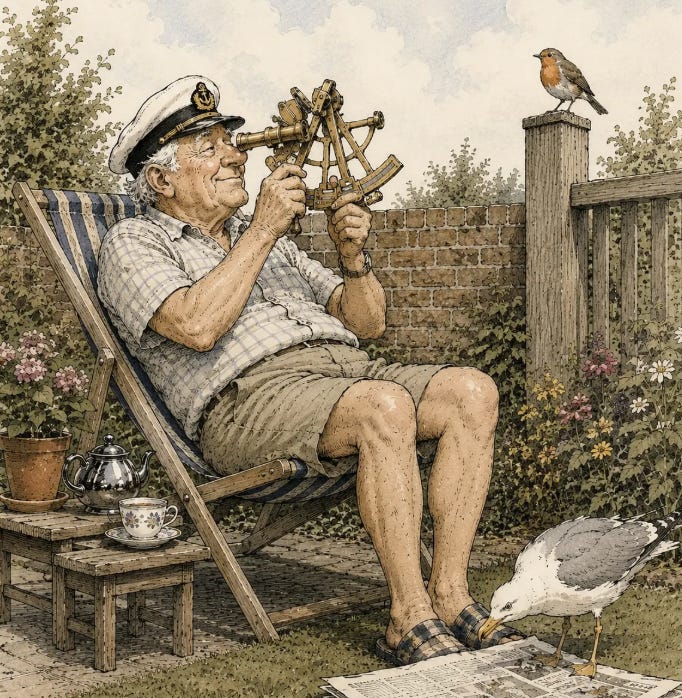
📖 A proper 25–30 minute read. Tea mandatory. Phone face down. You promised yourself.
This Week
What happens to attention when you finally stop being asked for things. A peculiar fact about a sealed cave in Israel, undisturbed for three hundred thousand years. An explanation of how navigators knew exactly where they were before satellites existed. And the quietest observation from a reader this week that stopped me mid-cup and didn’t quite let go.
Tea mandatory. Phone face down. The buffet can wait.
📋 In This Edition
Word Power
Quote of the Week
Peculiar Fact
From the Bridge: The Art of Knowing Where You Are
From the Sea
The Night the Sky Taught Her Not to Pity
What Landed This Week
Beyond the Instruments
Dad Joke + Cartoon
From the Archive
Worth Your Time
The Recommendation
Gumroad Nudge
Next Week + Sign-off
Word Power
SELFISH — Not the bad version. The earned version. Most people spend four or five decades being asked to show up, contribute, and subordinate their own interests to the requirements of their role. Then they retire. And some of them discover, slowly and with considerable guilt, that they have started doing things simply because they want to. Not because anyone is asking. Not because it contributes to a target. Not because someone is waiting. This is not selfishness in the way you were taught to mean it. This is the long-delayed business of existing on your own terms. It just feels suspicious after this long.
SET — A maritime word for invisible lateral movement. When a current pushes you sideways without your awareness or agreement. You are steering a course, watching the compass, ticking off the miles — and the sea is quietly taking you somewhere else. By the time you take a bearing, you are well off track, and the calculation of how to correct it requires knowing where you actually are, not where you intended to be. Retirement has set. Most people do not notice it for at least a year, by which point they are twelve miles from where they expected to be and have largely decided this was probably where they were heading all along.
ORDINARY — The most undervalued word in the language. Ordinary Tuesdays. Ordinary biscuits. The ordinary cup of tea you make at eleven o’clock because nothing requires your attention. The ordinary bird on the fence that turns out, once you look properly, to be a goldfinch — which you would never have noticed before because before, you were busy. Ordinary has been getting bad press for decades, mostly from people trying to sell you something they claim is better. It is not better. Ordinary is what all the best days turn out to have been, once you’re far enough away to see them.
Quote of the Week
“What if I had taken time to look, see, and DRAW the 50 cities I visited, instead of efficiently snapping photos?”
— Steve E Weeks, @steveeweeks
The photos exist. Hundreds of them, probably. The seeing barely happened. There is something specifically late-life about recognising the difference between recording an experience and actually having one — and then discovering, with some surprise, that you still have time to choose the other thing.
Peculiar Fact
Archaeologists excavating a cave in Israel this month have described it as a “time capsule.” They mean this literally.
The cave sealed itself approximately three hundred thousand years ago and has remained undisturbed since. Inside: stone tools, animal bones, and the careful remnants of a daily life lived before any written record, any city, any history worth measuring.
The people who sat by that fire had the same basic requirements as the person reading this on a Friday morning. They worried about something. They planned something. They almost certainly talked more than they listened — humans always have.
The tools they left behind are technically sophisticated for the period. Remarkably sophisticated, the archaeologists say. What I find remarkable is that everything those people did has been completely forgotten, and yet the tools remain, and from the photographs, they are beautiful.
(Source: 300,000-Year-Old Cave Site Explored in Northern Israel — Archaeology Magazine)
From the Bridge: The Art of Knowing Where You Are
Before satellites, there was a problem. It was the fundamental navigational problem. You are at sea. You cannot see land. You cannot see the bottom. There is nothing fixed within a hundred miles in any direction, and the sea is doing something below you and the wind is doing something above you and the current is doing something sideways — and you need to know, with enough accuracy to matter, exactly where you are.
The solution was called dead reckoning. The name is almost certainly a corruption of “deduced reckoning,” though maritime etymology is a surprisingly contentious field and no one is completely certain, which feels appropriate for a method that involved controlled guessing backed by mathematics.
The principle is this. You start from a known position — a harbour entrance, a lighthouse, a coastal fix taken at first light. You record your speed, your heading, and the elapsed time. You account, as best you can, for wind and current. You apply these calculations continuously, updating your estimated position every watch, every hour, every time something material changes. The position you arrive at is not measured. It is reasoned. It is the best possible answer given the information available, and it is only as good as the attention you have been paying.
What dead reckoning requires is continuous, careful presence. A navigator who pays attention every hour drifts less than one who checks once a day. This sounds obvious. In practice it is remarkably easy to become comfortable. The ship is running well. The sea is calm. The radar is clear. Nobody has called with problems. And then you look up and discover you are twelve miles from where you thought you were, and the charitable version of this is that the current was stronger than the chart predicted, and the honest version is that you stopped watching.
We used sextants for celestial navigation as well — taking precise angles from the sun or stars to calculate latitude and longitude. This was reliable but required clear skies and a reasonably stable platform, two things the North Sea declined to provide simultaneously with any consistency. Dead reckoning was the fallback. It was also, in its way, the more demanding skill, because it required something a sextant cannot give you: continuous engagement. You cannot take a single reading and leave. You have to keep tracking.
The navigators I respected most were the ones who knew where they were even when they couldn’t prove it. They had an instinct built from years of watching — the subtle wrongness of a current that didn’t quite match the chart, the way the colour of the water changed near a shoal, the behaviour of birds that indicated land not yet visible. None of this was formally measurable. All of it was reliable.
I am told that modern navigation is almost entirely satellite-dependent. I am told that some younger officers struggle when the GPS fails, because they have never needed anything else. I believe it. I also think this is a perfectly reasonable description of what has happened to quite a lot of other things as well.
The position you cannot prove but know in your bones is always more useful than the position you can measure but have stopped questioning.
From the Sea
There is a concept called set and drift. Set is the direction the current is pushing you. Drift is the rate. Together they describe the invisible force that moves you sideways while you are focused on going forward.
Experienced navigators account for set and drift continuously. You are always being pushed somewhere. The only question is whether you are conscious of it.
I have been thinking about this in the context of the first year after work ends. Not because I have navigated it with any particular skill — I have not, particularly — but because I have been watching it.
Set and drift in civilian life is harder to detect than at sea.
At sea you can take a bearing, look at the chart, do the arithmetic.
In retirement the markers are less precise.
You look up one day and discover you have become someone who watches two hours of television in the afternoon and considers this a reasonable use of Wednesday, and the unsettling thing is not that you are doing it.
The unsettling thing is that you cannot identify the exact moment when it stopped requiring justification.
The question dead reckoning asks is always the same: where did I start, what have I been doing, and does the position I arrive at match any reasonable calculation from the two?
It usually does.
The uncomfortable part is what you learn when you do the calculation honestly and don’t like the answer.
The Night the Sky Taught Her Not to Pity
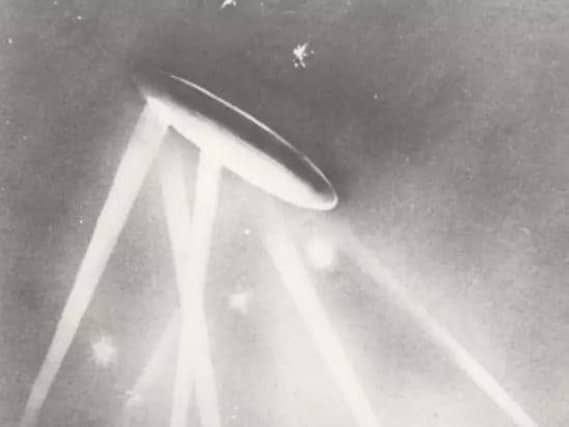
In 1916, Hartlepool learned that war was no longer something that happened far away. My grandmother was fourteen when she watched a German Zeppelin shot down in flames over the town.
She saw crewmen running from the fire, then jumping to their deaths rather than burn. What shocked me most was not the horror of what she saw, but her reaction.
She told me she felt no pity.
They had been trying to kill her, her family, her street, her reality.
At fourteen, she understood something brutal: innocence ends quickly when the sky itself becomes the enemy.
What Landed This Week
Steve E Weeks wrote something in the comments this week that I have been carrying around since. He was talking about a cartoon of two elderly men in front of a hi-fi, one explaining that what drew him to vinyl was the expense and inconvenience, and somewhere in the middle of his response he dropped this: “What if I had taken time to look, see, and DRAW the 50 cities I visited, instead of efficiently snapping photos?” I was professionally efficient for forty years. Efficiency, it turns out, is a remarkably good way of being somewhere without being there. I don’t think Steve meant this as an accusation. It landed as one anyway. A useful kind.
Signals Beneath The Surface offered a reframe that I’ve been sitting with since Tuesday: “I would offer that it could be called situational intimacy. Doesn’t mean it wasn’t real, just intimacy within a specific set of circumstances.” This was in response to the piece about colleagues and friends. I had been calling it loss. Situational intimacy is more accurate, and considerably kinder. Real within its circumstances. Genuine rather than permanent. I’m not sure this resolves anything. It changes the shape of it.
On Threads This Week
Sometimes an idea is too small for an essay but too interesting to ignore. That’s what Threads has become for me: the workshop before the newsletter, where half-formed thoughts are tested, challenged and occasionally improved. If you’d like to see tomorrow’s essays before they become today’s newsletter, you’ll find me there.
Beyond the Instruments- Clinical death?
A study published by researchers at the University of Southampton documented cardiac arrest patients who reported coherent, verifiable experiences during periods of clinical death — periods during which brain activity was measurably absent. Several of these patients described specific observations, later confirmed by medical staff, from positions that should have been physically impossible given that they were unconscious and supine throughout.
I make no claims. I spent forty years reading instruments, and I know what instruments can and cannot tell you. These instruments could not explain what they appeared to be measuring.
The honest navigational position is this: the evidence for something beyond physical consciousness is not conclusive. It is also not nothing. The cases are documented and peer-reviewed. The explanations typically offered — hallucination, oxygen deprivation, expectation effect — do not fully account for the externally verified observations. What the instruments record is that the brain was not doing what brains do. What some patients report is that something was.
I’ve been thinking about this. People it seems want to think about this.
We’re told we shouldn’t.
We do anyway. I suspect that itself is significant. (
Primary research: AWARE study — University of Southampton | Published in Resuscitation journal)
The Old Mans world

I had a passenger once aboard a cruise vessel who approached me on the bridge wing with what he clearly felt was an important question.
“Captain,” he said, with the solemnity of someone who had been thinking about this since the safety briefing, “if the ship sinks, do we really go down with it?”
I told him that was entirely at the Captain’s discretion. He looked uncertain whether this was reassuring. He was right to be uncertain.
What I did not say — because it would have taken considerably longer than the situation warranted, and the buffet had opened — is that the tradition originated from command responsibility rather than anything nautical about drowning.
The Captain’s duty was to remain aboard until every soul was safely off.
It meant standing on the bridge receiving reports from muster stations at three in the morning in full uniform, holding a manifest and counting heads.
The romance of the tradition and the administrative reality of the tradition are two entirely different things.
This is also, now I think about it, a reasonable description of retirement.
From the Archive
Three pieces connected to this week’s thread — what you notice when the world stops requiring your attention.
When The World Stops Asking — Fifteen minutes in the supermarket trying to choose teabags. The woman who reached past without hesitating. The piece about the specific kind of shrinking nobody warns you about. Everything since has, in some way, grown from this one.
The Younger Me Would Be Disappointed — About the alternative biography we carry with us. The parallel version of ourselves that never had to compromise. Worth reading on a Friday afternoon, slowly, with the good biscuits out.
Retirement Doesn’t Give You Freedom. It Takes Away Your Life. — The brochure promised cycling through vineyards in France. Nobody mentioned the other thing. This is the other thing.
Worth Your Time
An honest account of regrets at seventy, from someone who built a career across three continents — Sivakumar Ramanathan worked for decades in India, the Middle East, and the United States, then retired, and then asked the question that surfaces when the career ends: did I work harder than necessary, at the expense of the other things? He doesn’t answer neatly. That is precisely the value of it. A good five-minute read for anyone who has done the same arithmetic.
The clearest thing I’ve read about the difference between keeping busy and actually building a life — Lisa Schmidt writes about what she observed talking to dozens of people in the years after work. The ones who appear happiest are not the ones with the fullest calendars. They are the ones who stayed genuinely curious and were willing to let something new emerge rather than recreating the old structure in new clothing. Sounds simple. In practice it is quite a lot harder than scheduling a pottery class.
Essential Chart Work: Dead Reckoning — RYA Yachtmaster Theory Training — The Royal Yachting Association’s training video showing exactly how dead reckoning was done: parallel rules, dividers, paper charts, and the methodical attention that kept ships where they were supposed to be. Twelve minutes that make you understand what GPS quietly took away.
The Recommendation
Learning the names of birds. Properly. One at a time.
Not a book — a habit. This spring I started identifying what was actually visiting the garden rather than filing everything under “small brownish one” and “the fat grey one with opinions.” I bought the RSPB pocket field guide.
Forty pages in I had identified a goldfinch for the first time in six decades, which felt like being properly introduced to someone who had attended every occasion I’d attended and whom I had somehow never actually seen.
This is not birdwatching. I did not join a group, buy binoculars, or leave the house with any equipment. I stood at the kitchen window with a cup of Yorkshire Tea and a small book and began paying attention to what was already there. The goldfinch has been there for years. I simply was not looking.
Twenty minutes is enough to learn eight common garden birds well enough to name them on sight. There is no quiz. There is no achievement. There is just the quiet, specific, slightly embarrassing pleasure of a Tuesday morning when you know what the noise is and can put a name to it.
Who it’s for: anyone over fifty with a garden, a window, and a mild suspicion that they spent forty years not noticing things that were right there the whole time.
A Brain Nudge
The set-and-drift problem I wrote about this week — the invisible current taking you sideways while you focus on going forward — does not resolve by itself. What helps is having something that names what is actually happening before you realise you’ve drifted.
The Second Act Essentials Bundle covers four of the quietest challenges of the second half of life: why time feels heavier than it should now that you have more of it; why money carries guilt even when there is enough; why friendships thin without any argument or incident; and why freedom and direction are not, as it turns out, the same thing.
Not motivational. Not a plan. Four short, calm guides for the part of life the brochure declined to include.
Right. Here’s the awkward bit.
This newsletter has a paid version. I’m not going to explain what’s in it — if you’ve read this far you already know the shape of it. What I will tell you is that it costs 22 cents a day. Twenty-two. That’s less than a first-class stamp, less than the tea I’m making while I type this, and considerably less than whatever you spent this week on things you can’t quite remember.
If thirty minutes of your Thursday has been worth that, the button’s below. If it hasn’t, we’ll say no more about it.
(Buy Me a Tea also works, if the recurring thing isn’t your style.)
If this Magazine made you, think, nod, laugh, or mutter “actually, he’s got a point” — you’ll probably enjoy The Old Grey Thinker.
Want something more practical?
I’ve created a collection of guides for people who still believe life isn’t over just because the calendar says so. You’ll find them here:
The Quiet Income Playbook For anyone wondering whether it’s possible to earn a little extra without becoming an influencer, dancing on TikTok, or selling their dignity.
The Authenticity Stack 55 publishing prompts designed to help you build an audience, find your voice, and create online without sounding like a malfunctioning corporate chatbot.
Not everything needs a subscription. If this one landed, you can support it here.It’s not mandatory.
But neither is keeping the lights on.
Tea remains the official fuel source of The Old Grey Thinker.
One small favour, though.
If you enjoy the ramblings of a nearly 68-year-old ex-captain trying to make sense of a world that appears to have been designed by a committee of caffeinated squirrels, please share it with a couple of people who might enjoy it too.
I’m not shaking my fist at modern life.
Just my head.
Usually over a mug of Yorkshire Tea.
Naturally.
Also here is another very cool free tool by Cornell for identifying birds using their calls.
http://merlinbirdid.com
Thank you for the education on navigating and how GPS may have taken over and also taken the ability away from the younger set, which is unfortunate, especially if GPS fails out in the middle of the grey.