
Something for the Weekend, Issue 8

Three hundred years ago, cartographers kept drawing an island that didn’t exist, in the exact same spot, because nobody could be bothered to sail out and check. This week: the phantom island that fooled the British Admiralty until 1873, the one watch out of several thousand I still think about at three in the morning, and a Brazilian study confirming that most people who’ve felt something they can’t explain are, in fact, perfectly fine.
Word Power
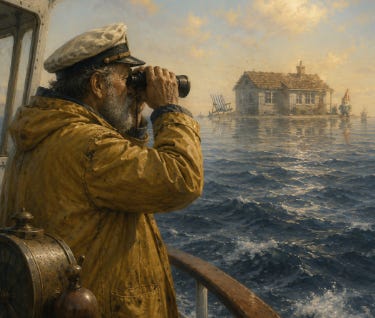
FATA MORGANA — A mirage caused by a temperature inversion, showing you land that isn’t there. Sailors used to see whole coastlines that vanished the moment they altered course towards them. I’ve come to think most ambitions work the same way in your fifties and sixties. Some are real islands. A good many are just warm air sitting on cold water, doing an excellent impression of somewhere worth going.
SOUNDING — The act of measuring the depth beneath you before you trust it with the whole ship. We still take soundings at sea, constantly, automatically, without a second thought. Most of us stopped taking them on our own lives somewhere around forty, and started steering entirely on the assumption the water underneath was still what it used to be.
BEARING — A fixed direction to a fixed point, taken so you can tell, later, whether you’ve drifted. You don’t need a destination to take a bearing. You just need one thing that isn’t moving, so you’ve got something to measure the drift against.
Quote of the Week
“If you’re not getting very far with your Bucket list I would change the B to an F and you’ll feel so much happier 😅”
— Brad , Substack Notes

I’ve been carrying a Bucket list for six years now that has, if I’m honest, mostly just accumulated more items than it’s lost. Brad’s version costs nothing, requires no equipment, and has an unusually high success rate.
Peculiar Fact
For three hundred years, European cartographers drew an island called Hy-Brasil off the west coast of Ireland — a perfect circle, always at the same latitude, appearing on maps by Mercator and the Ottoman cartographer Piri Reis alike, right up until the 1870s.
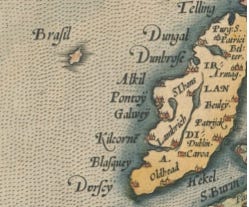
Nobody had ever landed on it. Nobody had ever really looked hard enough to say for certain it wasn’t there — the coordinates were mostly just copied, chart to chart, cartographer trusting cartographer trusting a rumour that was itself centuries old by that point.
Then, in the 1870s, the British Admiralty finally did what nobody else had bothered to do: they sailed out and took a sounding. Thousands of feet of water, nowhere near enough to hold an island. Hy-Brasil was quietly struck from every official chart by 1873, after outliving several empires on the strength of nobody checking.
Here’s the twist nobody expects: about twenty thousand years ago, when sea levels sat far lower than they do now, there really was a substantial island exactly where Hy-Brasil was drawn — what’s now a submerged plateau called the Porcupine Bank. The phantom island was never real in anyone’s lifetime who drew it.
It just happened to be drawn in the one place on the whole ocean where, a very long time before any of them, it actually had been.
From the Bridge: The Watch I Still Think About
It was a Tuesday, if the log’s to be believed, though at three in the morning on a bridge in thick fog every night feels like the same night. We were in a shipping lane off a coast I won’t name, because the coastline doesn’t matter and the ship doesn’t either — what matters is that the radar was showing a contact closing on a bearing that wasn’t quite changing fast enough, and every instrument on that bridge was telling me one thing while something else, something with no readout at all, was telling me something slightly different.
The book answer was clear. Standard avoiding action, alter to starboard, plenty of margin, a manoeuvre I’d made a hundred times without thinking twice. I started to give the order and then didn’t. I stood there instead, hand on the rail, watching a contact on a screen, for what was probably eleven seconds and felt considerably longer, because something about the closing rate didn’t match what a vessel behaving normally in that lane at that hour ought to be doing.
I altered the other way. Not dramatically — a few degrees, nothing that would have shown up as remarkable in any log entry anyone ever read afterwards. The other vessel, it turned out, was not maintaining a proper lookout and had been slowly, unknowingly, drifting off her own intended track for the better part of twenty minutes, which is precisely the kind of situation where the textbook manoeuvre and the actual safe manoeuvre occasionally, quietly, part company. Nothing happened. No incident, no report, no story anyone would tell in a bar. Two ships passed further apart than they might otherwise have, and everyone involved went on with their night entirely unaware anything had been decided at all.
I’ve thought about those eleven seconds more than almost anything else that happened across four decades at sea, and I still can’t fully explain what I was reading that the radar wasn’t showing me. Something about the rate. Something about ships that are exactly where they should be moving differently than ships that aren’t, in a way that doesn’t show up cleanly on any screen, only in the accumulated pattern-sense of having watched several thousand contacts close before that one. I’ve come to think that’s most of what forty years actually buys you — not more information than the instruments give you, but the ability to notice, occasionally, when the instruments and the situation have quietly stopped agreeing with each other, and to trust the noticing over the number.
From the Sea
Every course you steer has two versions: the one you intended, and the one you actually made good, and the gap between them has a name — set and drift, the current’s contribution to where you actually ended up, whether you asked for it or not.
A good navigator doesn’t pretend the drift isn’t happening.
He takes a fix, measures the gap honestly, and corrects — not with embarrassment, just with arithmetic. I spent a long time assuming a life worked the same way, that you could plot a course at twenty-five and simply hold it, correcting for nothing, arriving exactly where you’d aimed.
Nobody warns you that the set and drift never stop, that entire decades get quietly nudged sideways by currents you never agreed to and mostly never noticed, and that the people who end up furthest from anywhere useful aren’t usually the ones who drifted the most.
They’re the ones who never took a fix, and so never found out they’d been drifting at all.
What Landed This Week
Christine , on grief and the parts of ageing nobody’s built a button for: “The button for the grief that comes as friends die and their loss is pervasive in your life. No button for the loss of ‘looking forward’ to what comes next. No button for the fear that hides at the edges of your life that you realize will soon be over.” I don’t have a button for that either, Christine. I’m not sure anyone does. I think the honest answer is you keep taking soundings anyway, on faith that the depth is still there even on the days you can’t quite feel the bottom.
Julie, on preventive maintenance as a life philosophy: “I became a fan of ‘preventive maintenance.’ Not just for equipment, but for processes, too. Few people look up, or ahead, to see what might be coming... I much prefer getting good at regular oversight and action to keep things running than having to engage in ‘heroic’ action when stuff blows up.” This is, without exaggeration, the entire discipline of running a ship’s engine room condensed into four sentences by somebody who’s never stood in one. I’d have hired you.
Living with bipolar disorder, on what she’s stopped needing: “I don’t need a purpose. I don’t need ambition. I need to watch the breeze in the tree leaves. I need to watch my tea brew to just the right strength. I’m not old; I’m an elder, though, and I know what’s important.” I’m keeping “elder” over “old.” It’s doing considerably more work.
Beyond the Instruments
A team at Brazil’s Institute D’Or surveyed just over five thousand people about what researchers politely call “nonordinary experiences” — a sensed presence, an out-of-body moment, hearing a voice, feeling the dead in the room.
Published in PLOS One, the finding that actually matters is the least dramatic one: nearly half the people who report these experiences describe them as positive, and the researchers found no meaningful link to clinical illness.
Most of the people who’ve felt something they can’t explain, in other words, are simply people who’ve felt something they can’t explain. I spent thirty years reading instruments for a living, and the instruments never once measured the thing that made a ship feel, on certain nights, unmistakably watched.
I’m not claiming anything. I’m reporting what the log would say, if I kept one for this: readings inconclusive, crew unaffected, nothing to action.
Funny but True

A pilot boarding a container ship I had command of once looked genuinely offended that we hadn’t lowered the pilot ladder to what he considered a professional standard, muttered something uncomplimentary in two languages, climbed it anyway with the easy contempt of a man who’d done it eleven thousand times, and then, once safely on the bridge, spent the first four minutes of a genuinely difficult river passage telling me, entirely unprompted, about his grandson’s exam results.
We brought a thirty-thousand-tonne ship up a narrowing river doing forty per cent conversation about a fourteen-year-old’s geography grade and sixty per cent actual navigation, and it went, I should say, extremely well.
I’ve come to think the ratio matters less than people assume. What matters is that somebody’s paying proper attention underneath the chat, and pilots, in my experience, always are.
From the Archive
Someone Asked If I’d Found My Purpose Yet. I Nearly Choked on My Tea. — What “finding your purpose” actually sounds like from the wrong end of the question.https://theoldgreythinker.substack.com/p/someone-asked-if-id-found-my-purpose
My Neighbour Got a Fitness Tracker (I Got a Kingfisher and He Didn’t) — On measuring a good week two entirely different ways.https://theoldgreythinker.substack.com/p/my-neighbour-got-a-fitness-tracker
I Started Lying to My Smart TV — What happens when the house gets a little too observant. sending. https://theoldgreythinker.substack.com/p/i-started-lying-to-my-smart-tv
Worth Your Time
The interstellar hum nobody can explain — Since 2017, Voyager 1’s plasma wave instrument has picked up a continuous, unexplained “hum” in interstellar space, published in Nature Astronomy, across a stretch of space ten times the distance from here to the sun. Every model predicted interstellar space would be quiet. It isn’t. Worth five minutes, purely for the scale of it.
Why hardship makes conspiracy theories more appealing — but only sometimes — A Nottingham/Cumbria study of 1,284 people found hardship alone doesn’t predict conspiracy belief. It’s hardship that convinces you the world is fundamentally unfair that does. A genuinely useful distinction, and a kinder one than most coverage of this topic manages.
The “spaceship” in the Baltic that turned out to be ice — A quick, well-made explainer on the 2011 Baltic Sea sonar anomaly that had half the internet convinced of a sunken UFO. It was a glacial rock formation. I include it not because the answer is thrilling, but because it’s a useful reminder that “explained” and “boring” aren’t the same word.
Guest post - Wisdom from an unlikely friend an even OLDER Grey thinker....
“A long time ago I met an old Russian geezer. He had spent many years in a Siberian labour camp for what, in Stalinist Russia, was the heinous crime of persisting in his religious beliefs. He said to me: ‘In a world of meaning everything has meaning; in a world of no meaning, nothing has meaning. I can’t conceive of a world in which some things have meaning and others have none.’
At the time I thought it was a cute soundbite at best, sophistry at worst. But over the years his observation has begun to bite in a different way. For he was touching on a profound truth: we have one life and two choices: either to live in a meaningful world, or to live in a world in which nothing has meaning. We only get one shot at it.
When one is younger, the distinction doesn’t matter so much. We are busy with our lives: climbing the greasy pole as much to satisfy our competitive egos as to earn a crust; building families and relationships, if good fortune smiles.
Then, after all of that is over, we enter a new zone - the one The Old Grey Thinker keeps banging on about. And then the old Russian’s words strike you hard. In a world of meaning, YOU have meaning, your LIFE has meaning, even NOW, for as long as you live and are able to shuffle around. In a world of no meaning, you and your entire life - all that you have ‘achieved’ in the past, and all that you still aspire to do - mean nothing. You are no more than an insignificant speck of life in a vast universe, here for a moment and forgotten tomorrow.
It’s time to make a choice.
I am older than The Old Grey Thinker by more than a decade. But we have something in common. We continue to strive to live meaningful lives and, more importantly, ones that we hope have a positive impact on those who are kind enough to subscribe to the musings of two unrepentant greybeards. Our Substack offerings are different. But underneath the differences we are saying the same thing:
When you stop living with meaning and purpose, you stop living altogether.”
Thanks Shlomo.
Greys- do your self a favour and check out Shlomo Levin MBE
Gumroad Nudge
If this issue’s had you thinking about soundings and drift and how long it’s been since you honestly measured either — I built The Second Act Essentials Bundle for exactly that stocktake. It won’t hand you a fixed point to steer by. It might help you work out which one you’re actually using.
Next Week
Next week, From the Bridge flips back to an explainer — the actual mechanics of how a ship finds a single fixed point in open water with nothing but a sextant, a clock, and considerable patience, and why that method still quietly underpins half of modern navigation whether anyone admits it or not.
One for the comments: when did you last take an honest sounding of your own life — actually measure the depth, rather than just assuming the water’s still what it used to be?
Tea’s getting cold. Go on.
P.S. — If this landed, forward it to one person. Just one. That’s how this grows.
Want something more practical?
I’ve created a collection of guides for people who still believe life isn’t over just because the calendar says so. You’ll find them here:
Not everything needs a subscription. If this one landed, you can support it here:
So far- every article is interesting & helpful - love your work -& thanks for introducing Schlomo too - ❣️
Really interesting read. Thank you 🙏 Love the F....list quote.