
My Generation Got Everything. Then We Voted to Take It Away.
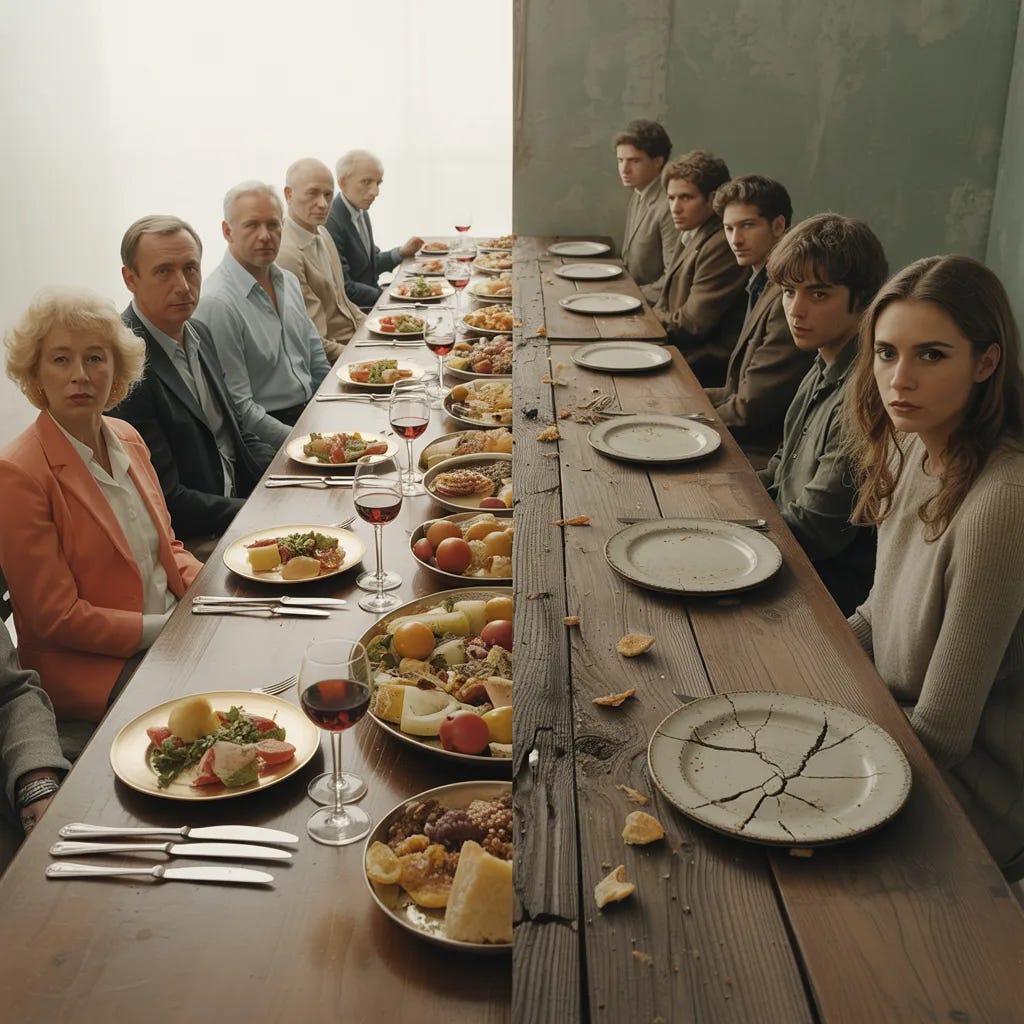
It has to be discussed.
There’s a conversation I’ve never heard anyone in my generation actually have.
Not at dinner, not at the pub, not in the letters pages of the newspapers we still read.
We talk around it constantly — the cost of living, the housing crisis, the NHS waiting times — and we talk about it as though it’s weather.
Something happening to someone somewhere. Something unfortunate.
Nothing whatsoever to do with us.
I’m 67. I grew up in the northeast, left school into a world that handed things over quietly, without ceremony, as though they’d always be there. A job that lasted. A mortgage I could afford on one wage. A university system that cost nothing. An NHS that arrived when you needed it and, crucially, arrived quite quickly. I didn’t think of any of this as a gift at the time. I thought of it as Tuesday.
We — my generation, the ones born in the late fifties and early sixties — received the full suite. The houses that appreciated faster than sense allowed. The final-salary pensions. The free university places. The jobs that lasted thirty years and ended with a handshake and a carriage clock and enough to live on afterwards. The pension age that let you stop before your back gave out completely. None of this was luck, exactly. Most of us worked hard. But we worked hard inside a system broadly designed to reward working hard, and that distinction matters more than we’ve ever been willing to say. There is a difference between earning your place and earning your place from a starting position nobody mentions. We started from a starting position nobody mentioned. And we chose, for the most part, to keep it that way.
Here’s the part nobody says out loud. We didn’t just receive all of this and stay quiet about it. We voted, repeatedly and with great conviction, for the people who dismantled it for everyone who came after us. Tuition fees — introduced by governments we put in power. The housing shortage — decades of planning decisions we endorsed at every ballot. The NHS — not destroyed overnight but thinned steadily through choices we made. We received free university degrees and then voted for tuition fees for the generation behind us, which is the rough equivalent of pulling up the drawbridge from the inside and calling it fiscal responsibility.
I’m not sure anger is the right response to any of this. Embarrassment, perhaps. The thing about arriving at 67 is that you’ve run out of excuses. The performance is over. You can’t claim you didn’t understand what you were voting for, not after the third or fourth time. You can only notice what you know and say it plainly, which is — unexpectedly — one of the more valuable freedoms retirement turns out to offer.
The young aren’t failing. They’re navigating conditions that would have floored most of us at their age. House prices that require two incomes and a decade of saving for a deposit that keeps moving. Student debt before they’ve even started. A jobs market where a permanent contract has become a privilege. An NHS they wait months to access. A retirement system — if it still exists in any recognisable form by the time they reach it — that will bear no resemblance to the one we collected.
They didn’t build these conditions. We built them, or allowed them to be built, or voted for the people who built them while telling ourselves it was about something else entirely.
I don’t know what you do with that realisation.
I genuinely don’t.
I just know that standing around discussing the work ethic of people in their thirties is no longer something I can manage with a straight face.
And I suspect I’m not the only one in my generation who has quietly, privately, arrived at the same conclusion — even if nobody’s saying it at dinner yet.
You’re seeing what I leave open. The rest goes further.- If you are paid subscriber no need for any further action but if you are free then …..
Not everything needs a subscription. If this one landed, you can support it here:
I think this happened when everything became a commodity and everyone fell for the lie that as long as we continue to produce and consume then nothing could take away the bright future.
So we all bought into private pensions and sunk savings into gambling on house price rises forever. We stopped looking at the roots of a strong society and were dazzled by the bright shining things the market dangled before us.
I’m not in the UK, but your list of failing institutions in which we once placed faith struck a cord. I am beyond 67 (let’s leave it at that) and have no defense except that old tired metaphor about the frog in water that eventually boils.
The voices that actually explained the consequences of our actions were few and far between. In our country, it is about getting reelected. After the first term, the politician belongs to the highest bidder and the upstarts have no chance against the money machine that keeps things the same or gradually sells them out to their pet interests.
I’m not making excuses; I’m trying to actually think it through. It’s only in the last decade of my life that I have come to understand economic policies or cultural foundations with a wide enough perspective to see where it began to go wrong. I frankly did not have the wherewithal to find out what was really happening in any depth when I was much younger. I was working, raising children - all while in the pot of water that was slowly getting hotter and hotter. I honestly wish I had paid more attention. That would have resulted in a better outcome for my children.
This article is humble and wise and honest, and I appreciate it.