
I Stopped Verifying Things When the Consequences of Being Wrong Stopped Mattering
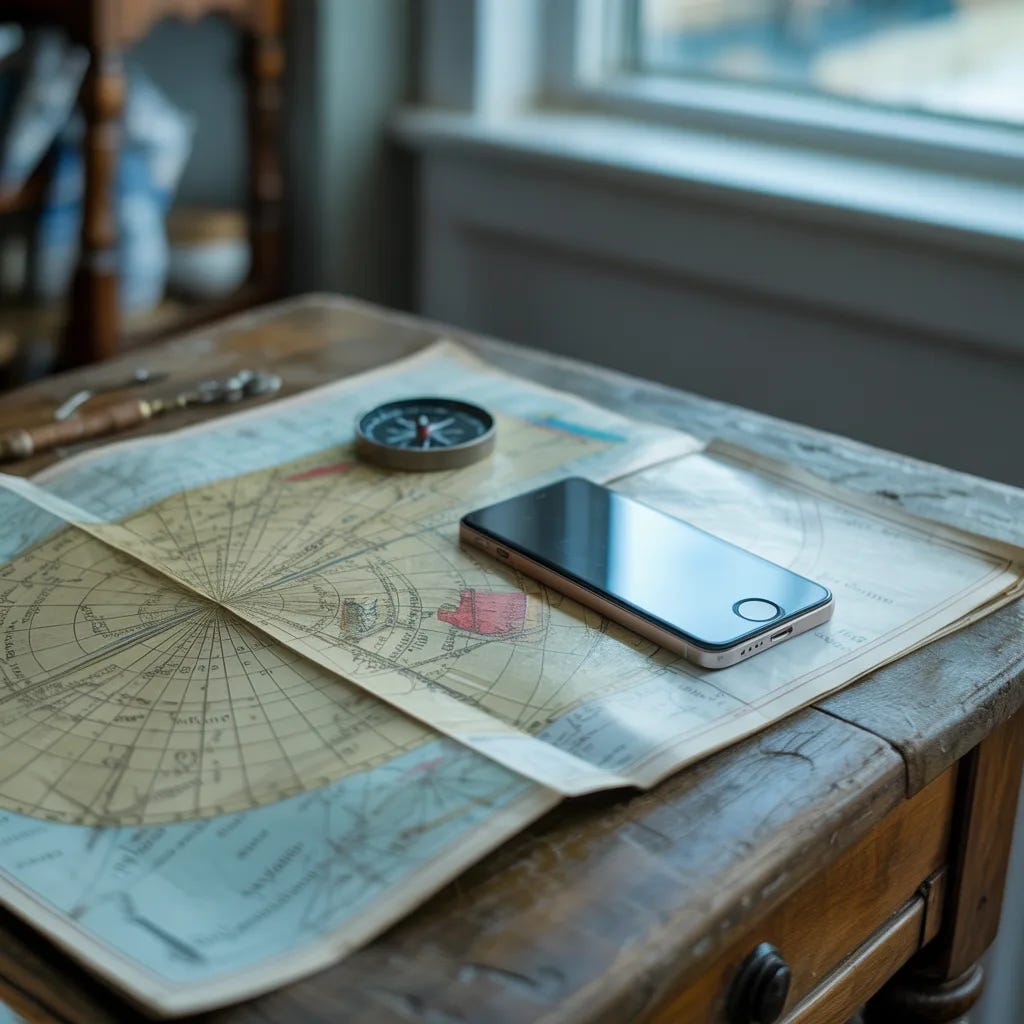
At sea, I never trusted one source of position information.
This is not personal fastidiousness — it is the professional minimum. GPS, chart, echo sounder, and the navigator’s own reckoning: each independently fallible, each checked against the others.
The coincidence of all four pointing to the same place is not redundancy.
It’s confirmation.
You verify because the sea does not forgive the error you didn’t look for, and because the feedback on the error, when it comes, is immediate and tends to be expensive.
I have been retired for nearly a year.
The habit is dissolving.
Not cartographically — I still read maps, still prefer to understand terrain rather than be told where I am. That’s a different thing. What I’m describing is the general professional reflex: find a second source before trusting the first.
Check the conclusion against the evidence rather than the evidence against the conclusion. Maintain the suspicion that information arriving unchallenged is information that hasn’t been tested.
Ashore, the consequences of being wrong are smaller.
This has turned out to matter more than I expected.
If I accept the wrong position from a map, I get briefly lost in North East England.
If I accept a wrong piece of information about something in the news, or about my health, or about how money works, nothing immediate happens.
The error will probably manifest later, gradually, in ways that can’t be traced back cleanly to the moment I didn’t check.
The feedback loop that made verification automatic at sea — the immediate consequence that punished the unchecked assumption — is gone.
And without the feedback loop, the habit is quietly eroding.
Here is the uncomfortable part: the things I’m most confident about in retirement are the things I’ve verified least.
I noticed this recently while examining an opinion I had held as settled for several years.
I couldn’t find the source of it.
There had been, at some point, an article, or a conversation, or a feeling, and I had accepted it as position information and had not subsequently checked it against anything.
No second source.
No chart.
No echo sounder.
I had navigated by one reading and called it orientation.
At sea, the professional term for this is dead reckoning. You proceed on the best available estimate, knowing it will drift from the truth over time, and the discipline is to keep checking and correcting rather than letting the drift compound. The unchecked dead reckoning is the one that puts you on the rocks.
I recently discovered I had been asserting a fact about North Sea tidal drift with considerable confidence for approximately seven years.
I checked it last month out of mild curiosity. The fact is wrong in a way that suggests I may have invented it sometime around 2018, agreed with myself about it on at least two separate occasions, and then filed it under confirmed knowledge. I cannot now locate the original source because I appear to be it.
Ashore, I have been doing unchecked dead reckoning on things that matter.
Conclusions about health.
About politics.
About what the world is like now and what it’s likely to become.
I have been forming positions and then mostly leaving them there, because verifying them is effortful and the consequence of not verifying them is invisible.
The sea made the consequence visible and imminent.
Ashore, it is deferred and diffuse.
I am not sure this doesn’t matter.
At sixty-seven, the consequences of the errors I’m not checking for are not trivial. The health decision made on insufficient information. The financial assumption that goes untested for a decade. The view of the world that hardens into certainty because nothing challenged it early enough. These are the navigational errors of the third act, and they accumulate slowly, and the feedback when it comes is harder to read than a ship on the ground.
I think about the GPS confirming the chart. The chart confirming the GPS. The echo sounder announcing the depth matches what the chart says should be there. The professional insistence on agreement between sources, not because any single source was unreliable, but because reliability requires confirmation.
The habit isn’t gone.
It’s resting.
The question is whether I’m willing to let it rest indefinitely, or whether the things I haven’t checked are worth the effort of checking them.
I’m less comfortable with the answer than I was this time last month.
You’re seeing what I leave open. The rest goes further.- If you are paid subscriber no need for any further action but if you are free then …..
Not everything needs a subscription. If this one landed, you can support it here:
For those who want to go deeper, I’ve created extended guides and resources at my Gumroad page — practical tools for thinking and creating in our fast-paced world.
PS If you’re trying to work out what to do next — without hype or reinvention …….
— I have 2 new things up on Gumroad. The Quiet Income Playbook
and, but you’re probably not ready for this: The Authenticity Stack: 55 Prompts to Build a Publishing Business Without Sounding Like ChatGP
This is fantastic. I’ve written an entire book, A NEW TRUE TO ME, about verifying things I believed throughout my life. The introduction includes:
“From that first day of writing to this finished book, writing forced me to appreciate the differences between true, true-to-me, and a new-true-to-me. True is always TRUE, while TRUE TO ME is only what I believe to be true at a point in time—an opinion. As long as any of us can take in new information, there is opportunity to find a more accurate truth—A NEW TRUE TO ME. True-to-me, or anyone, has a timestamp, whether we choose to recognize it or not.”
A fantastic article and perspective. I feel the same way on things I don’t get challenged or don’t challenge enough.